
Contents
The verdict in four linesAll seven NFC business cards compared: hardware price, software price, the catch1. V1CE — when the card itself is the pitch, from $56 to a $270 gold plate2. Popl — the events machine, where hardware is the cheapest part3. Mobilo — the cheapest custom hardware, with $3-a-month software behind it4. Linq — a $14.99 card built for the follow-up, not the tap5. Tapt — pay $40 to $65 once, own the card outright6. Wave — a $23 card with no drama attached7. TapTag — from $3.95, and genuinely no subscription8. DBC — the no-hardware option: the card that is only the linkWhat an NFC card cannot do without softwareWho should skip NFC business cards entirelyConclusionFAQBest NFC Business Cards (2026): Real Prices, Honest Verdicts
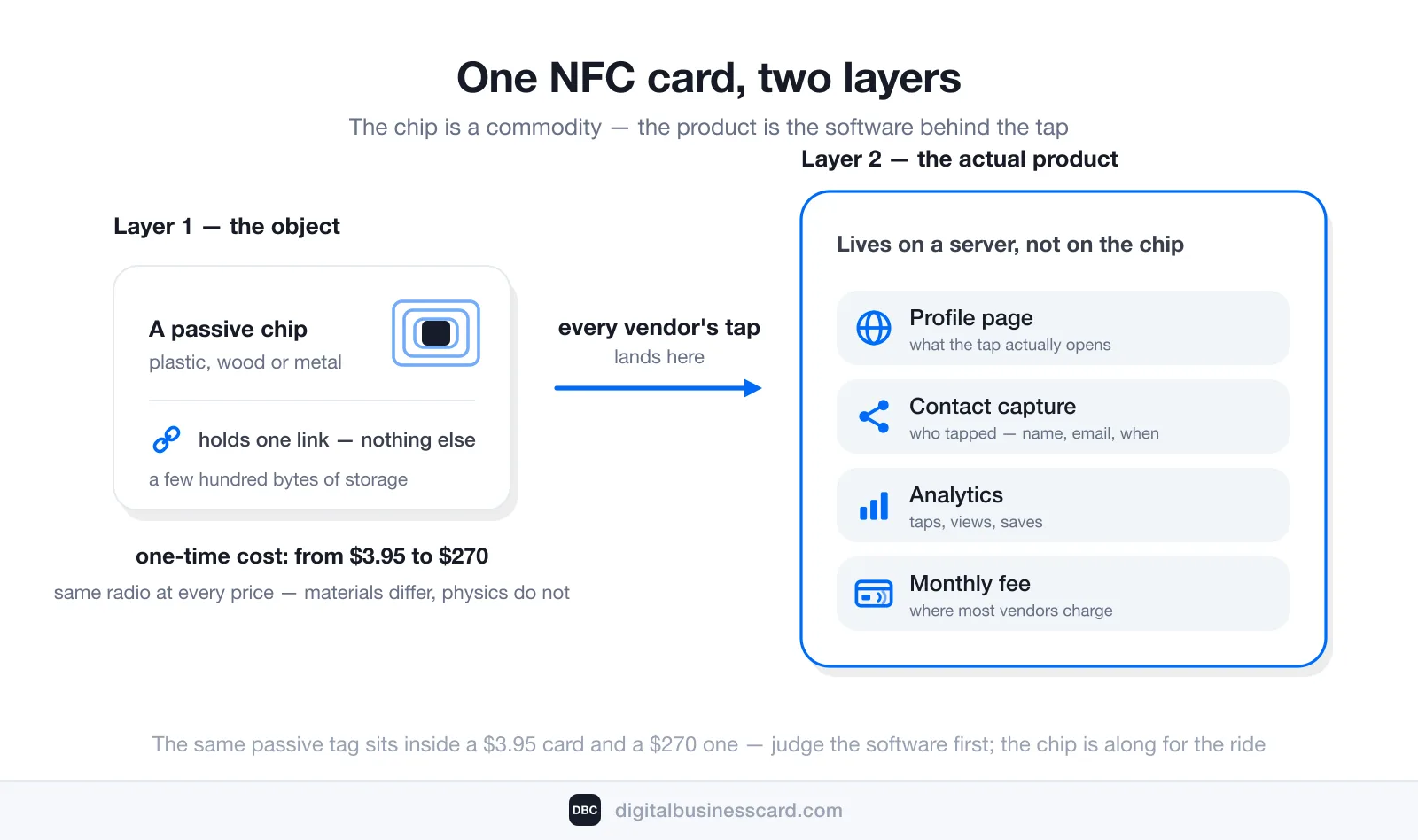
The best NFC business card in 2026 depends on which half of the product you are actually buying. The chip is a commodity — the same passive tag sits inside a $3.95 TapTag and a $270 gold-plated V1CE — so the real comparison is what stands behind the tap: the profile page, the contact capture, the monthly fee that some vendors mention only at checkout.
We compared seven hardware vendors on prices pulled from their own stores in August 2026 — V1CE, Popl, Mobilo, Linq, Tapt, Wave and TapTag — and then did what most roundups skip: separated the cost of the object from the cost of the software, because in this market they are almost never the same purchase.
Two scope notes so you land on the right page. If you want the chip itself explained — what an NFC tag physically is, why phones flash "NFC tag detected" — that is our NFC tag guide. If you are comparing digital business card apps rather than physical cards, that field is ranked in our best digital business cards roundup. This page is about the objects: chipped plastic, wood and metal you hand across a table.
The verdict in four lines
- Best card as an object: V1CE — nothing else here feels like it, and the price says so.
- Best team value: Mobilo — custom cards from $39 with the cheapest serious subscription in the market.
- Cheapest way to try a tap: TapTag — from $3.95, genuinely no subscription.
- Best reason to buy no card: a software-first card like ours — the link does the work, and the tap is one surface among four.
All seven NFC business cards compared: hardware price, software price, the catch
Every vendor below sells the same physics — a passive chip your phone reads from a couple of centimeters. What differs is the price of the object, the price of the software, and how honestly the two are separated at checkout.
Vendor | Hardware (Aug 2026) | Software | The catch |
|---|---|---|---|
V1CE | From ~$56 plastic; ~$90 metal; ~$270 24K gold | Free tier; paid plan sold separately | You pay per employee card, per redesign |
Popl | Devices from ~$19.99 | Pro $7.99/mo; Teams — quote only | Team pricing not published at all |
Mobilo | $19.99 branded; $39 custom; $139 metal (promos run lower) | Pro $3/mo; Business $5/user/mo annual | The good analytics live in the subscription |
Linq | Card $14.99 | Free tier; Premium ~$7.49/mo | The card is the cheap half on purpose |
Tapt | $40 eco; $45 black; $65 custom | Free tier; paid upgrades | Up to 14 days to dispatch custom cards |
Wave | $23 standard; $42 custom; $54 metal | Free tier; Pro $7/mo | Simpler analytics than the sales-focused tools |
TapTag | From $3.95 classic; $29.95 custom plastic; $79.95 gold-plated steel | Free forever, per their site | Lighter software: profile and dashboard, not a CRM |
DBC (us) | None — we sell no hardware | $6.99/user/mo billed annually | You bring your own tag if you want a tap |
Prices are what each vendor's store showed in August 2026; several run rotating promotions, so treat them as the shape of the cost, not a quote.
1. V1CE — when the card itself is the pitch, from $56 to a $270 gold plate
V1CE is the vendor to buy from when the object in your hand does part of the selling. The range runs from The Original at around $56 through bamboo, brushed metal at about $90, up to a solid 24K gold plate at roughly $270 in USD terms as of August 2026 — on the UK store, which we checked directly, the same range runs £60 to £330. Design service is included, and build quality is the thing reviewers consistently agree on.
The honest framing: you are paying for materials and finish, not for better radio — the chip in the gold card opens a profile exactly as fast as the one in the plastic. A software plan with analytics is sold separately on top of a free tier, and a team putting metal in every rep's pocket is signing up for about $90 a head before anyone captures a lead, plus a reprint whenever a printed title changes.
Buy it if: you are in a field where a heavy card genuinely closes distance — luxury real estate, wealth management, founders raising. Skip it if: the budget line says "per employee."
2. Popl — the events machine, where hardware is the cheapest part
Popl has drifted furthest from being a card company: it now leads with event lead capture, badge scanning and CRM enrichment, and the NFC devices — from around $19.99, sold mostly through their Amazon storefront — are accessories to that system. For individuals, Pro runs $7.99 per month (around $6.40 on annual billing) and Pro+ $14.99; the plan-by-plan detail is in our Popl pricing review.
The detail worth knowing before a team evaluates it: Popl no longer publishes team pricing at all. Their pricing page says it outright — "we quote pricing over a meeting instead of publishing it on our website." That is an enterprise sales motion, and it tells you who the product is now for.
Buy it if: you run trade-show booths and the badge-scanning pipeline is the real purchase. Skip it if: you wanted a card with a visible price tag.
3. Mobilo — the cheapest custom hardware, with $3-a-month software behind it
Mobilo wins the value column. List prices as of August 2026: $19.99 for a Mobilo-branded card, $39 custom, $59 wood, $139 metal — and the store runs aggressive promotions that cut those to as little as $5–$20 with 90 days of the Pro plan included. The subscriptions are the market's cheapest serious ones: Pro at $3 per month, Business at $5 per user per month billed annually, with CRM sync and an admin dashboard on team tiers.
The trade-off is that Mobilo's hardware is unremarkable as an object — perfectly fine plastic and wood, nothing a client will photograph. The pitch is arithmetic, not craft: a ten-person team fully equipped costs less than two V1CE metal cards, software included, with central control of what every card shows.
Buy it if: you are equipping a team and someone will actually look at the analytics. Skip it if: the card needs to impress anyone with its build.
4. Linq — a $14.99 card built for the follow-up, not the tap
Linq prices the card at $14.99 — verified on their store in August 2026 — and that number tells you the strategy: the hardware is deliberately the cheap half. What Linq actually sells is what happens after the tap: lead capture forms, tagging, automated follow-up sequences, CRM handoff. The free tier covers basic sharing; Premium runs about $7.49 per month, with team plans above it.
In practice this makes Linq the pick for salespeople and consultants — people whose problem is not "I need a cooler card" but "I meet thirty people a week and follow up with six." The card triggers a workflow. If you never intend to pay for the workflow, you have bought a $14.99 object with a free profile behind it — fine, but TapTag does that for less.
Buy it if: the follow-up sequence is the feature you want. Skip it if: you will never subscribe — the card alone is not the point here.
5. Tapt — pay $40 to $65 once, own the card outright
Tapt sells the most straightforward deal in the list: a Lite eco card at $40, the Tapt Black at $45, a fully custom-printed card at $65 per their US store as of August 2026, each tied to an editable profile with a free tier underneath and paid upgrades for analytics and team features. The Australian company has built a clean, design-literate product without V1CE's price tag.
Two caveats from our check. Custom cards are made to order — Tapt's store quotes up to 14 days to dispatch, which rules out next week's conference. And the deeper analytics sit in paid plans, so the pay-once framing is true for the object and softer for the platform. Still, between commodity plastic and luxury metal, Tapt occupies the sensible center of this market.
Buy it if: you want a good-looking custom card at a defensible price and can wait for it. Skip it if: the event is this week.
6. Wave — a $23 card with no drama attached
Wave is the budget pick that does not feel like one. The standard Wave card is $23, custom-printed cards start at $42, and metal versions run $54–$76 per their store as of August 2026. The software follows the same logic: a workable free tier, with a Pro plan at $7 per month for analytics and deeper customization, and a $5-per-user Teams tier above it, per their pricing page in August 2026.
What you give up relative to Popl or Linq is the sales machinery — Wave's capture and analytics suit a freelancer, not a quota-carrying team. What you get is the absence of friction: order card, set up profile, tap. For many buyers that is the entire requirement, and Wave meets it at one of the lowest hardware prices of any custom-card option here.
Buy it if: you want one custom card and a low-cost app behind it. Skip it if: you need CRM integrations doing real work.
7. TapTag — from $3.95, and genuinely no subscription
TapTag answers a specific suspicion: "is this category just a subscription wrapped around a $1 chip?" Classic cards were listed from $3.95 on sale (regular $15.95) in August 2026, custom plastic from $29.95, cherry wood and bamboo at $26.95, and anodized steel from $49.95 up to a gold-plated card at $79.95. The site's promise, quoted: "No subscriptions required to share your contact" — the profile and dashboard are free, forever.
The honest counterweight: the free-forever software is the lighter kind — a profile and a dashboard, not lead funnels or CRM enrichment. TapTag is what this hardware looks like when nobody is upselling you, which makes it the right first purchase for the curious and the right permanent choice for anyone whose need ends at "my details, one tap, no monthly fee."
Buy it if: you want the tap without a recurring line item. Skip it if: you need the software to do more than display.
8. DBC — the no-hardware option: the card that is only the link
Full disclosure before this entry: this is our product, and we sell no NFC hardware at all. We are on this list because the previous seven entries share one load-bearing fact — the chip only ever holds a link, and everything the receiver sees lives at that link. A DBC card is the link: a live profile at digitalbusinesscard.com/your-name, shared by QR code, direct link, Apple or Google Wallet pass — or by an NFC tap, written to any tag or chipped card you already own, including any card from the vendors above. The receiver installs nothing; Save Contact hands their phone a standard vCard.
The Individual plan is $6.99 per user per month, billed annually — paid from day one, no free tier — and it includes what this market usually meters: two-way lead capture, analytics on views and saves, unlimited cards, design-first templates. A year of it costs less than one V1CE metal card, and when your title changes you edit a field instead of reordering steel.
Choose this if: you want the working half of an NFC card — the live profile, the capture, the analytics — without buying an object to carry it. Skip it if: the physical hand-over moment is itself the product you are buying.
What an NFC card cannot do without software
Every card above, from $3.95 to $270, is physically the same thing: a passive chip storing a few hundred bytes — enough for a web address and very little else. That has consequences the product photography does not show.
- It cannot update itself. The chip holds whatever link was written to it — if that link points at a static or dead page, the card faithfully delivers it forever. Everything current about you lives on the server behind the link.
- It cannot capture anything. A tap pushes your page to their phone. Learning who tapped — name, email, when — is lead capture, which is software, which is why it sits in every vendor's paid tier.
- It cannot report anything. Taps, views, saves, which conference produced which contacts: all analytics, all server-side, all subscription.
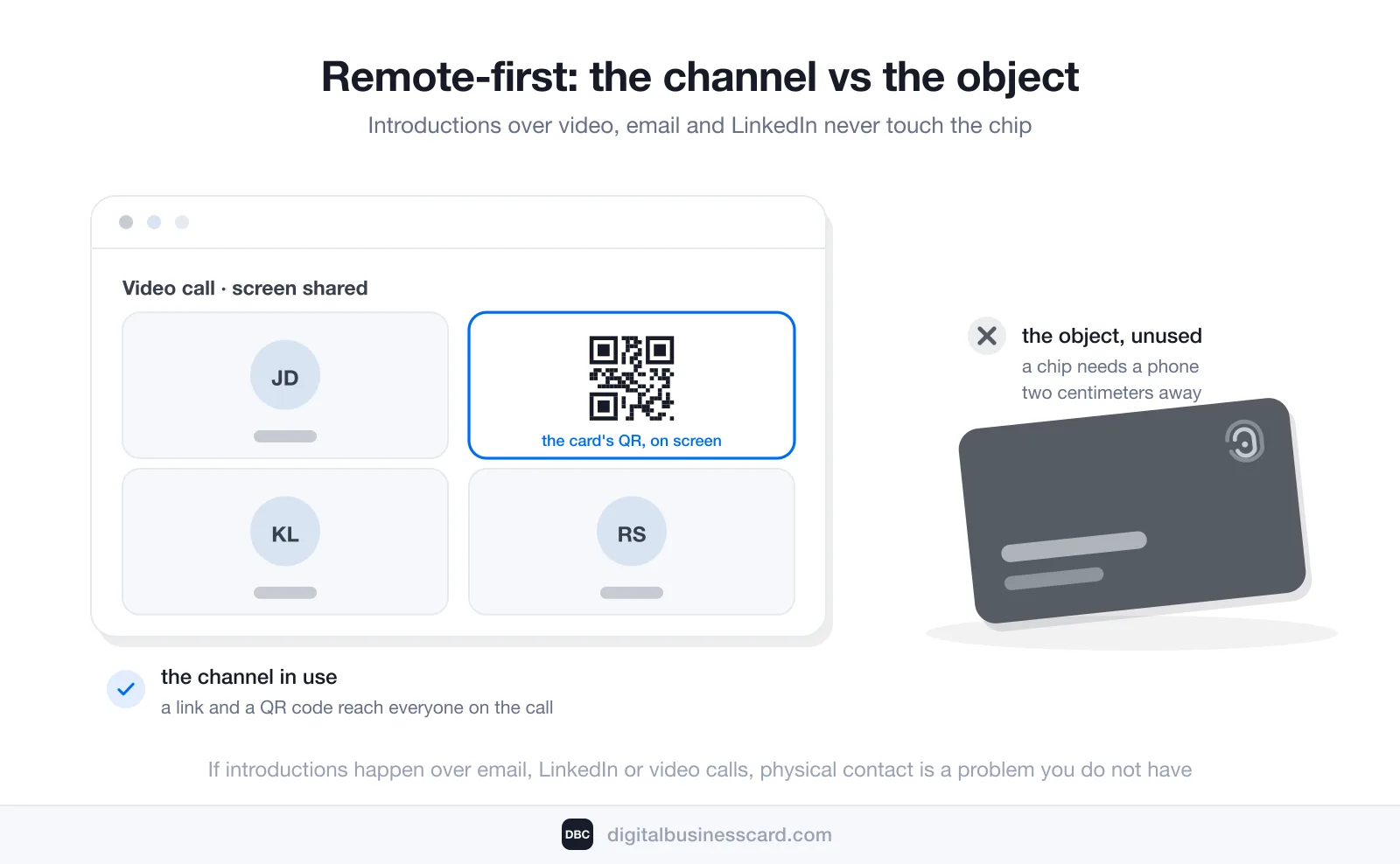
- It cannot reach anyone remotely. A chip needs a phone two centimeters away. Email signatures, LinkedIn, video calls, wallet passes — every remote channel is the software sharing the same link without the card.
None of this is a flaw — it is the architecture, as our NFC tag guide explains from the chip's side. But it reframes the buying decision: the hardware vendors on this page are all, structurally, software companies with a plastics supplier. Judge the software first; the chip is along for the ride.
Who should skip NFC business cards entirely
A physical card earns its price in one situation: high-volume, in-person networking where the object and gesture carry weight. Outside it, several kinds of buyer are better off with none.
- Remote-first professionals. If introductions happen over email, LinkedIn or video calls, a chip that requires physical contact solves a problem you do not have. A link and a QR code cover every channel you actually use.
- Anyone who already owns a tag. Blank chipped cards and stickers cost a dollar or two; writing your card's link to one gets the identical receiver experience.
- Teams with turnover. Personalized hardware becomes e-waste with every departure and rebrand. A software card is reassigned in a minute; a box of engraved metal is not.
- Budget-first buyers. The uncomfortable math of this roundup: for most vendors the card is $15–$90 plus the subscription that makes it useful. If you are paying for software either way, the object is optional.
Conclusion
If you came for a one-line answer: buy V1CE when the card must impress, Mobilo when a team needs taps on a budget, TapTag when you want the tap with no monthly fee — and buy nothing when you realize the part you actually wanted is the live page behind the link. The chip is a delivery mechanism; the card it delivers is software. That is not our spin — it is how every vendor on this page prices, which is why their checkout has a subscription in it.
We build the software half, and only that half: one permanent link, shared by tap, scan, wallet pass or plain URL, with capture and analytics included from day one.
FAQ
What is the best NFC business card in 2026?
How much does an NFC business card cost?
Do NFC business cards need a subscription?
Can I use my own NFC tag with a digital business card?
Are metal NFC business cards worth it?

A content writer with over 8 years of experience creating analytical content for digital products and B2B SaaS companies. His work focuses on practical guides, pricing breakdowns, and comparisons that help teams evaluate costs, features, and differences between tools.
Your first impression decides everything
- Look professional and build trust instantly
- Forget about reprints and lost contacts
- Update your details anytime
 Get Started Today