
Contents
Dot Card Team Pricing SnapshotDot Card Teams Pricing Overview (Plans, Limits, and Costs)Dot Card Pricing Breakdown for a 100-User Team (Annual Cost)Is Dot Digital Business Card Pricing Worth It for Companies and Teams?DBC vs Dot Card: Pricing Comparison for a 100-User TeamConclusionFAQHow Much Is a Dot Card? $30 Cards, $8/User Teams (2026)
How much is a Dot Card? A physical Dot Card costs $30 one-time for the standard dot.card, dot.classic, or dot.thin ($50 for dot.metal), and the basic dot.Profile is free. For teams, the Essential plan is $8 per member per month, billed annually (self-serve for up to 100 members), and the Growth plan is $15 per member per month for teams of 1–15 — beyond that, pricing is custom. That puts a 100-user team on Essential at $9,600 per year, versus $5,988 for the same team on DBC’s Business plan ($4.99 per card per month, billed annually). All prices verified against dotcards.net in July 2026.
Dot Card is a digital business card company based in Los Angeles that builds tools for professionals, entrepreneurs, and companies to improve how they share and collect contact information.
Founded in 2020, Dot Card positioned itself as a straightforward networking solution that replaces traditional paper cards with NFC and QR digital profiles supported by physical devices. If you are new to the hardware side of this, our explainer on what an NFC tag is covers what actually sits inside those cards and what it can and cannot store.
Over time, the platform expanded beyond individual use and introduced team and business plans. These plans combine digital profile management with lead capture features designed for team use.
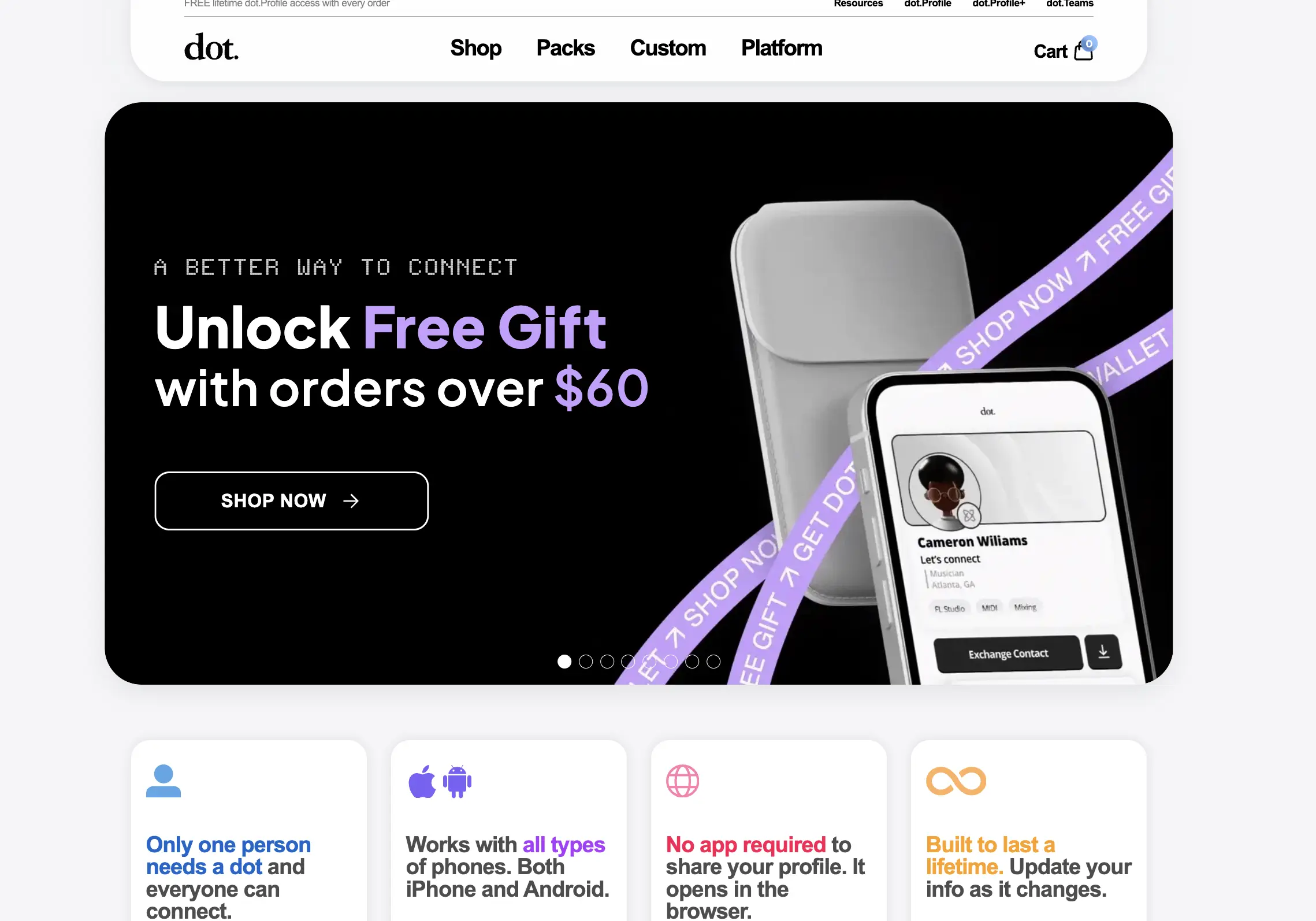
In this article, I take a close look at how much Dot Card costs for companies in 2026 and what teams should expect if they need more than basic features.
Read on to see the exact numbers, the annual Dot Card cost for a 100-member team, and a pricing comparison with DBC: Digital Business Card, which offers a higher ROI for growing teams.
Dot Card Team Pricing Snapshot
Dot Card uses a per-user pricing model for teams with annual billing only.
- The Essential plan starts at $8 per user per month, billed annually, and is available with public pricing for teams of up to 100 users.
- Once a team exceeds 100 users, pricing for the Essential plan becomes custom.
- The Growth plan costs $15 per user per month for teams of 1 to 15 users, billed annually.
- For teams larger than 15 users, Growth pricing becomes custom, regardless of team size.
Dot Card Teams Pricing Overview (Plans, Limits, and Costs)
For companies, Dot Card offers two team plans: Essential and Growth. The Essential plan has publicly listed pricing and is available for teams of up to 100 members. Teams that need additional features must move to the Growth plan and contact the sales team to learn the pricing.
Dot Card Business Plan Feature Comparison: Essential vs Growth
Below is a comparison of the features included in the Dot Card Essential and Growth plans.
Feature Category | Essential Plan | Growth Plan |
|---|---|---|
Team management | Basic team controls | Advanced team controls |
Profile templates | Included | Included |
Branding options | Limited | Expanded branding and white label |
Lead capture | Basic | Advanced lead management |
Analytics | Limited insights | Team networking insights |
CRM integrations | Not included | Included |
Physical devices | Standard devices | Custom devices with extended warranty |
Pricing transparency | Public | Custom, requires sales contact |
Dot Card Team Essential
The Essential plan is designed for small to mid-sized teams that need a simple and centralized way to manage digital business card profiles without advanced customization or integrations.
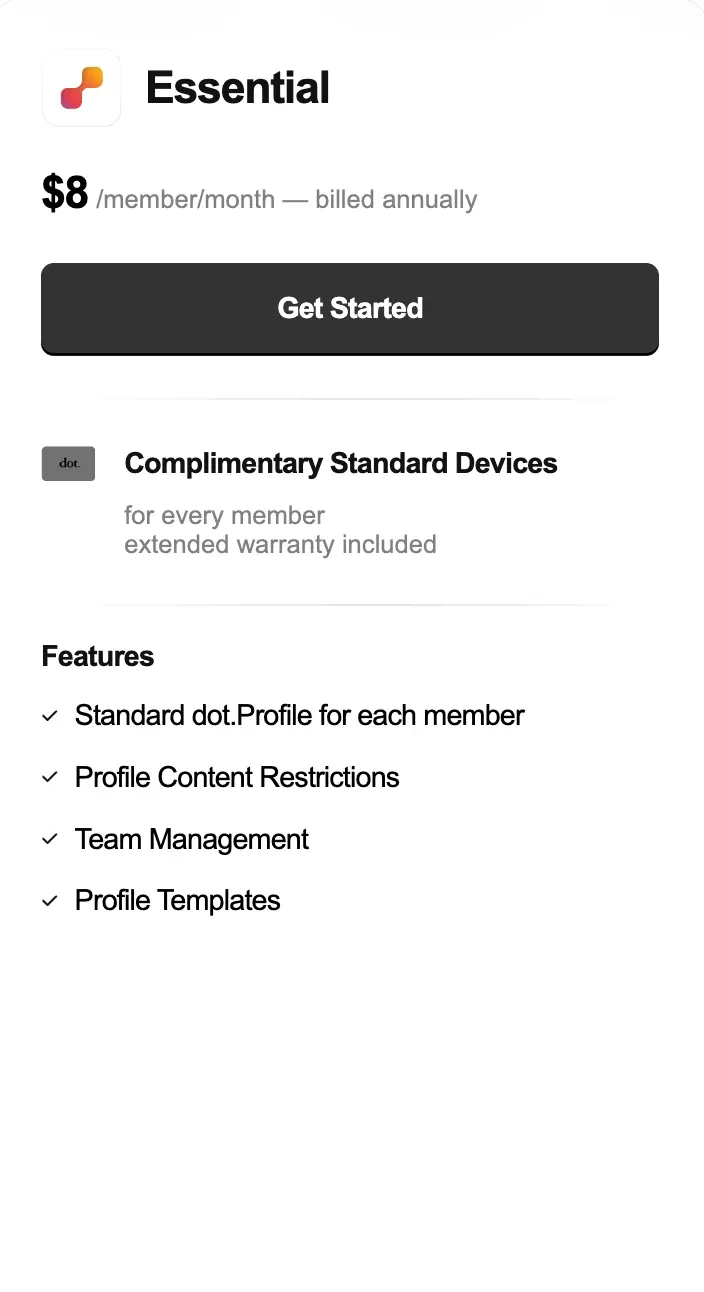
- Team management for members and profiles.
- Profile templates and basic content restrictions.
- Standard dot.Profile for each team member.
- Complimentary standard physical Dot Cards with extended warranty.
The Essential plan works best for teams that:
- are moving from paper business cards to digital profiles;
- need centralized profile management for team members;
- do not require CRM integrations or advanced analytics.
- prefer predictable and transparent pricing.
Essential plan works well as a starting point for teams that want predictable costs and a standardized setup. However, as soon as branding, analytics, or integrations become part of the workflow, teams often reach the limits of what Essential can offer.
Dot Card Team Growth
The Growth plan is Dot Card’s advanced team offering built for companies that require more control, visibility, and customization. For small teams of up to 15 users, the Growth plan starts at $15 per user per month, billed annually. For larger teams, pricing becomes custom.
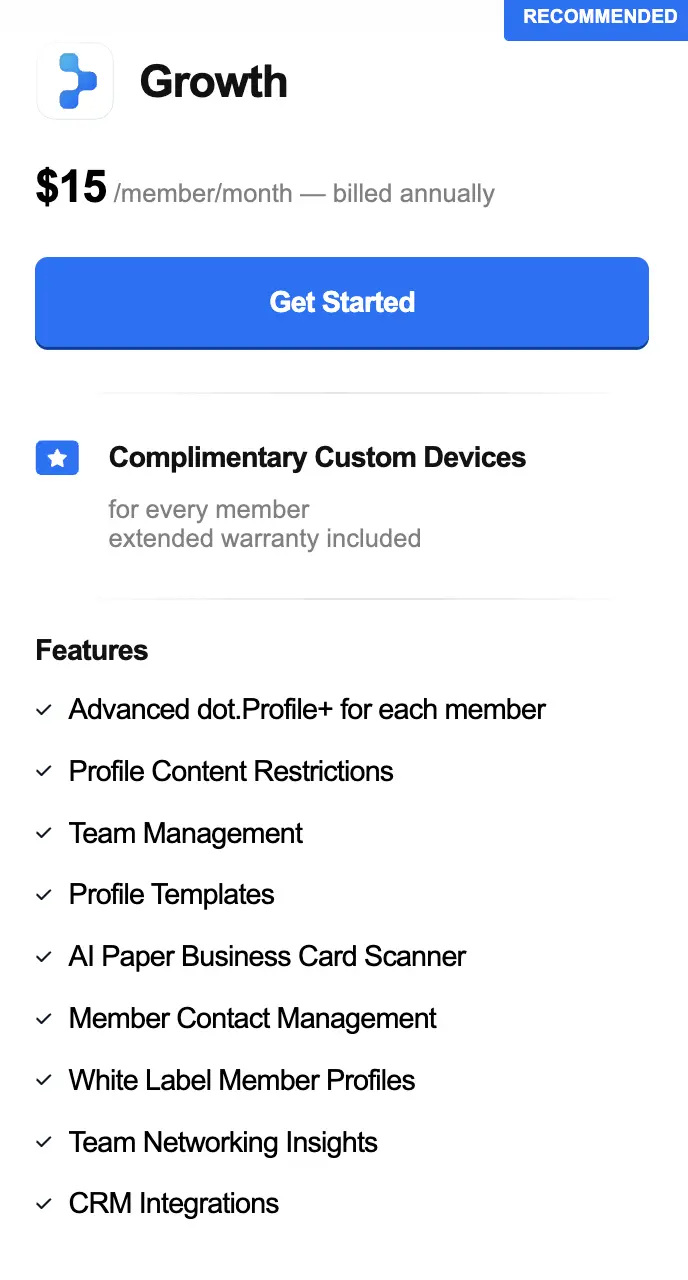
- White label member profiles with custom branding.
- Advanced member permissions and profile restrictions.
- Member contact management and lead tools.
- Team networking insights and extended analytics.
- CRM integrations.
- AI-powered paper business card scanner.
- Custom physical Dot Cards with extended warranty.
The Growth plan is best suited for companies that:
- need full branding control across team profiles;
- rely on lead tracking and contact management workflows;
- want to connect Dot Card data with CRM systems;
- operate at scale and require deeper insights into networking activity.
The Growth plan is designed for teams that have outgrown basic profile management and need deeper visibility into networking. Its broader feature set comes with less pricing transparency, requiring teams to balance functionality with cost predictability.
Main Differences Between Dot Card Plans
The Essential and Growth plans differ in three core areas: feature scope, customization, and pricing approach.
1. Only the Essential plan has publicly available pricing, while Growth pricing is not disclosed on the website.
2. White label member profiles and full branding control are available only in the Growth plan.
3. CRM integrations, contact management, and lead tools are included only in the Growth plan.
4. Team networking insights and extended analytics are not available in the Essential plan.
5. AI-powered paper business card scanning is included only with the Growth plan.
6. Custom physical devices are included with the Growth plan, while the Essential plan provides standard devices.
In short, the Essential plan focuses on standardized profiles and predictable pricing, while the Growth plan adds branding, analytics, and integrations at the cost of pricing transparency.
Key Limitations in Dot Card Business Plans
- No visibility into how Growth pricing scales as team size increases beyond the entry-level plan.
- Advanced features are locked behind a single upgrade, with no option to enable branding, analytics, or integrations individually.
- Annual billing is required, which limits flexibility for teams that want shorter commitments or phased rollouts.
- Hardware is bundled into team plans by default, even if a company prefers a software-only solution.
Overall, Dot Card’s team pricing model prioritizes bundled features and annual commitments over modular upgrades and cost flexibility.
Dot Card Pricing Breakdown for a 100-User Team (Annual Cost)
Dot Card charges team customers on a per-user, annual billing model. Pricing is calculated per team member and billed upfront for the full year.
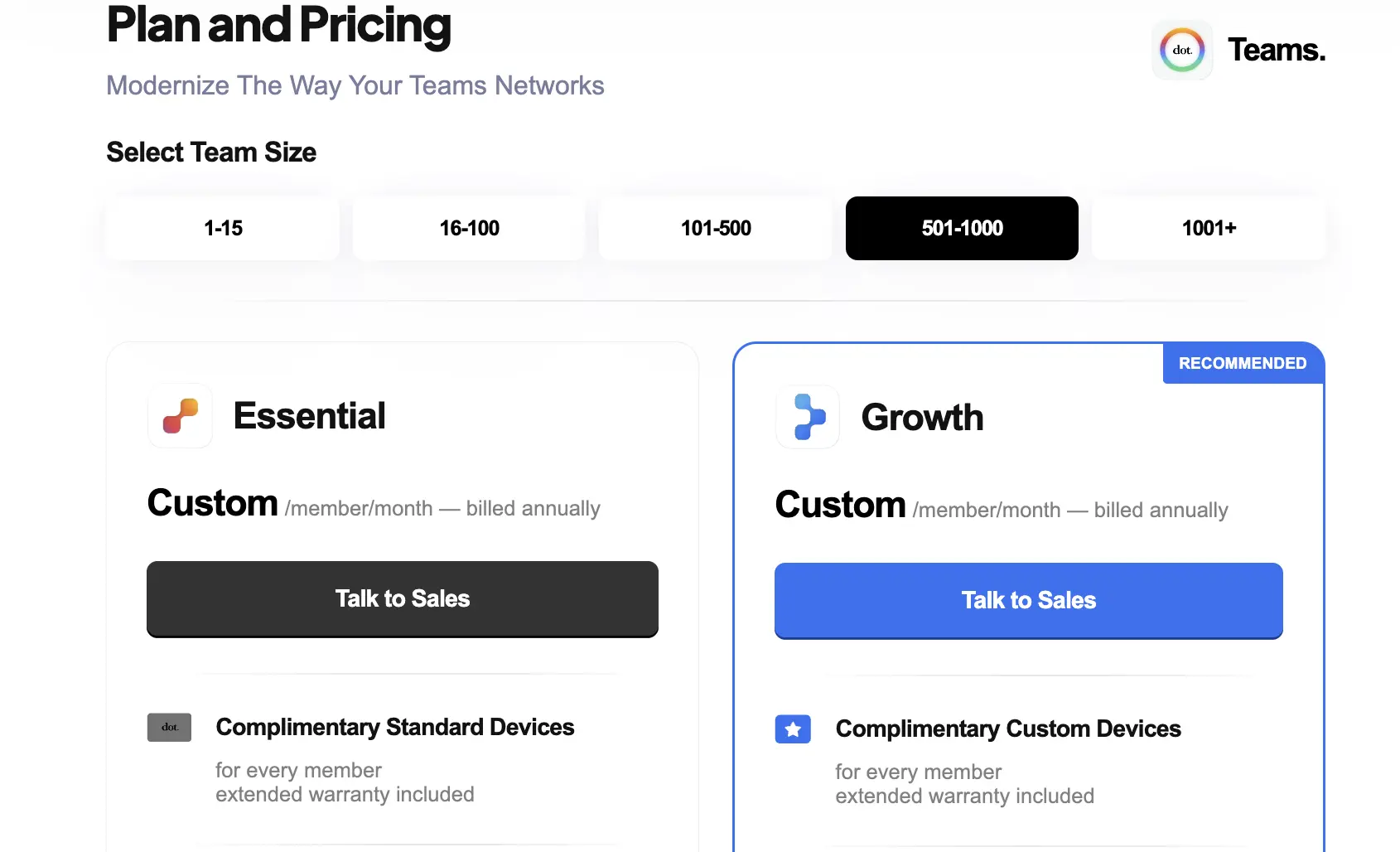
To estimate the total cost for a team, I multiply the per-user monthly rate by the number of users and then by 12 months.
Dot Card Essential Plan Cost for a 100-User Team
The Essential plan is priced at $8 per user per month when billed annually and is available as a ready-to-use option for teams of up to 100 users.
For a team of 100 users:- Monthly cost: 100 × $8 = $800
- Annual cost: $800 × 12 = $9,600
It is important to keep in mind that at this price level, teams do not get access to analytics or integrations.
Dot Card Growth Plan Cost for a 100-User Team
For a 100-user team, the total annual cost cannot be calculated without engaging with the sales team. While the Growth plan adds branding, analytics, contact management, and integrations, the absence of visible pricing makes it difficult to compare costs directly against the Essential plan or alternative solutions.
As a result, teams considering the Growth plan must evaluate functionality first and address pricing as a separate step.
Is Dot Digital Business Card Pricing Worth It for Companies and Teams?
With the Essential plan, a team of 100 users pays $9,600 per year. This gives companies a predictable starting point, but it also sets a hard ceiling on how much value the platform can deliver at a team level.
Once a company needs capabilities commonly expected from team-wide digital business card solutions, the Essential plan no longer applies. At that point, pricing moves to the Growth plan, where the total annual cost depends on your company's requirements.
For many teams, this creates a practical dilemma. The entry price seems reasonable in isolation, but scaling beyond it requires committing to a cost structure that is not clearly defined at the planning stage.
Before making any decision, it is worth comparing Dot Card with options that deliver all of the functionality Dot Card lacks at a more favorable price. In the next section, we compare Dot Card with DBC: Digital Business Card to show how total cost and ROI differ for a 100-user team.
DBC vs Dot Card: Pricing Comparison for a 100-User Team
For a team of 100 users, DBC: Digital Business Card uses the Business plan, priced at $4.99 per card per month, billed annually.
Calculation
- Monthly cost: $4.99 × 100 users = $499
- Annual cost: $499 × 12 months = $5,988
This price includes team usage, admin dashboard, CRM integrations, centralized contact management, and analytics with no add-ons or hidden fees.
Dot Card vs DBC: Cost Comparison Table
Platform | Users | Annual Cost | Notes |
|---|---|---|---|
Dot Card Essential | 100 | $9,600 / year | Fixed price, limited team functionality |
DBC: Digital Business Card | 100 | $5,988 / year | Analytics, CRM sync, team-first workflows |
For a 100-user team, DBC costs $5,988 per year, compared to $9,600 per year for Dot Card’s Essential plan. This makes DBC approximately 60% more cost-effective at the same team size.
More importantly, DBC provides your team with analytics, integrations, and centralized team workflows at this price point, while Dot Card pushes you to a custom plan to unlock the same functionality.
If you are from a team that wants long-term cost efficiency and predictable scaling, you can’t ignore this pricing gap.
Conclusion
Dot Card’s pricing structure is built for teams that want a simple entry into digital business cards, with physical NFC cards and centralized profile management. At the entry level, costs remain predictable, but unlocking broader team functionality requires moving into a less clearly defined pricing model.
As team requirements grow, companies often find themselves balancing feature needs against pricing friction, especially when digital business cards are expected to support analytics, integrations, and scalable workflows rather than basic profile sharing. For a step back to the fundamentals — what these products are and what they replace — see our guide to what a digital business card is.
For many teams, this raises a practical question:
Does the current setup still match how the business operates today?This is where companies start exploring Dot Card alternatives to find platforms that deliver the missing capabilities with clearer pricing and fewer trade-offs at scale.
One cost-efficient option is DBC: Digital Business Card for Companies, a B2B platform that supports analytics, integrations, and predictable scaling without enterprise pricing or complex upgrade paths.
FAQ
Is Dot Card pricing predictable for teams?
Is Dot Card pricing worth it for companies that need analytics and CRM integration?
What limitations should I expect at Dot Card’s entry price point?
What mistakes should I avoid when budgeting for Dot Card pricing?

A content writer with over 8 years of experience creating analytical content for digital products and B2B SaaS companies. His work focuses on practical guides, pricing breakdowns, and comparisons that help teams evaluate costs, features, and differences between tools.
Your first impression decides everything
- Look professional and build trust instantly
- Forget about reprints and lost contacts
- Update your details anytime
 Get Started Today